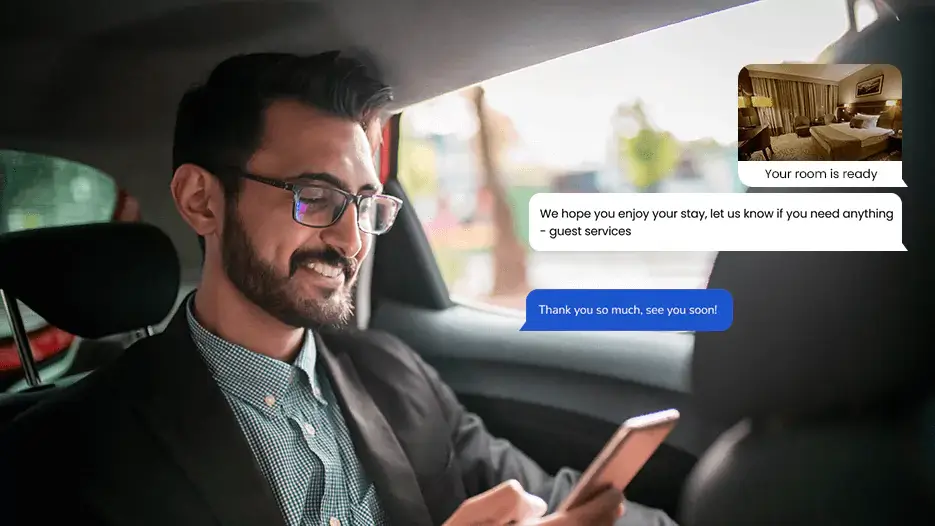
Most hotels are sitting on a gold mine of guest engagement opportunities and leaving them untouched because their messaging stack can’t keep up with the channels guests actually use.
From SMS and WhatsApp to Booking.com threads, Airbnb chats, and Instagram DMs, the average guest expectation is to be able to reach your property the same way they reach anyone else in their life: quickly, on whatever platform feels natural to them.
Over 65% of travelers now expect hotels to respond within an hour across any channel, yet most properties still manage each platform as a separate silo, with different staff members monitoring different inboxes.
65%
of travelers expect hotels to respond within an hour
The result is missed messages, inconsistent service, and guests who feel like strangers even when they’ve stayed with you before. Hotel guest messaging technology exists to solve this, and in 2026, the best systems do far more than centralize a chat inbox.
This guide covers what hotel guest messaging is, why it matters, the trends reshaping it, and 12 of the leading platforms available today.
What is hotel guest messaging?
Hotel guest messaging is the practice of communicating with guests throughout the traveler’s journey, from before they book to weeks after they check out, across digital channels including SMS, email, WhatsApp, Facebook Messenger, OTA platforms, and live chat.
Hotel management that leverages guest messaging as part of its strategy can engage with guests in ways that are meaningful to them. Different demographics and personas have different guest preferences, so defining your target audience and understanding their preferred channels is the foundation of any effective hotel guest messaging strategy.
Many guest messaging systems (GMS) integrate with a property management system (PMS) so that front desk staff can track guest requests, automate workflows, and give the entire team a single view of every guest interaction. Popular use cases include:
- Sending a pre-arrival registration card for frictionless check-in
- Offering room upgrades and upsell opportunities at the right moment in the guest journey
- Providing a digital concierge with the wi-fi password, a property map, and local recommendations
- Conducting a mid-stay check-in to catch service issues before they become bad reviews
- Guest requests like room service orders or service reservations
- Routing maintenance requests to the right team automatically
- Sending post-stay surveys and review requests to satisfied guests
The opportunities to communicate with guests across the guest journey are extensive and increasingly important to both guest satisfaction scores and ancillary revenue.
How should hotels communicate with guests?
The answer depends on the guests you’re welcoming and the tools you have to manage volume. Some properties invest in a full omnichannel platform connected to the PMS; others start with a single channel like WhatsApp for Business or text messaging.
What matters most is consistency and responsiveness. 73% of travelers prefer messaging over traditional phone calls when reaching out to hotels, and messaging platforms have a 90% open rate within three minutes — far outperforming the 20% phone answer rates during busy periods.
73%
of travelers prefer messaging
90%
open rate within 3 minutes
Not all tools serve the same purpose. Some focus on individual communication channels, while others use AI to automate common guest inquiries. The most advanced platforms unify communication across every channel and connect directly with the PMS, giving hotel teams a complete view of the guest journey in one place.
Below are the four main categories of hotel guest messaging technology and how they’re commonly used across hotels.
1. Messenger for business
Platforms like WhatsApp, Facebook Messenger, and WeChat offer business-facing messaging tools designed for direct consumer communication. These channels work well for properties that want to engage guests on familiar platforms, particularly for pre-arrival questions and in-stay requests where urgency is low. They work best as one channel within a broader strategy rather than a standalone solution.
2. Chatbots
Chatbots are AI-powered applications that respond intelligently to guest inquiries without requiring staff intervention.
Rule-based chatbots follow pre-set logic (if a guest asks about check-in times, show this response). AI-powered chatbots go further — interpreting intent, responding in natural language, and adapting to questions they haven’t seen before. For properties fielding hundreds of common questions per week, an AI chatbot can resolve the majority of inquiries without any human involvement.
3. OTA messaging
Online travel agencies like Booking.com, Airbnb, Expedia, and Vrbo all have built-in guest messaging systems that travelers increasingly expect hotels to use. OTA messaging is particularly important for pre-arrival questions, check-in coordination, and support during the stay because guests often prefer to communicate within the platform they booked through.
The challenge for hotels is operational. Managing multiple OTA inboxes separately can quickly become overwhelming, especially for lean teams.
The most comprehensive option is a dedicated guest messaging platform, where messages from every channel (SMS, WhatsApp, email, OTA inboxes) arrive in one unified inbox. Whether a guest is messaging via Airbnb or texting from their own phone, hotel staff see and respond from one place.
These platforms are best for properties that want a communication strategy spanning the full guest journey, from pre-booking through post-stay. For independent hotels operating with lean teams, they’re particularly valuable: automation handles the routine interactions, freeing staff to focus on the guest interactions that genuinely benefit from a human touch.
Messaging platforms also create new revenue opportunities through well-timed upselling, add-ons, and special offers. A pre-arrival message offering a room upgrade or a late check-out costs nothing to send and can materially improve both revenue and the guest’s stay.
When using a guest messaging platform, hotels are able to keep track of messages using the following functionality.
Unified inbox
A unified inbox consolidates messages from all platforms into a single workspace. Instead of monitoring separate tabs and risking missed messages, your team works from one place with full conversation history and context.
During Passport, Chris Hovanessian, Senior Product Manager at Cloudbeds, described how this changes hotel operations in practice:
We’re facilitating millions of messages every month and automating countless tasks around the clock. The unified inbox combines all your channels into one shared workspace — SMS, email, OTA communication, and more. Your staff don’t need to switch between two different platforms. It’s right there in their workspace.
At Vermont’s Opera Inn Killington, the unified inbox became one of the most impactful parts of the team’s entire operation:
Watch the full session.
See how to deliver high-touch hospitality at scale.
Staff ticketing and workflow management
When a guest sends a request, a guest messaging platform can automatically route it to the right department and create a service ticket. A maintenance request goes to the maintenance team; a housekeeping request goes to housekeeping. Staff respond directly from the ticket, keeping all communication in one traceable thread, giving management visibility into response times and resolution rates across the property.
AI-powered responses
For common questions — check-in times, parking, wi-fi, house rules, late check-out policies — AI can handle the full response cycle without any staff involvement. The guest gets an immediate, accurate answer at any hour. Staff get their time back for interactions that actually need them.
The newest generation of hospitality AI doesn’t rely on generic scripts. It learns from your specific property: your website, your OTA listings, your own SOPs and training manuals. So responses reflect your property’s voice, not a template.
Trends in guest messaging
Guest messaging is evolving rapidly. What started as simple SMS notifications has expanded into fully connected communication ecosystems
Here are some of the biggest trends shaping guest messaging this year.
1. AI-powered personalization at every touchpoint
The most effective guest messaging platforms are deeply integrated with PMS data, enabling automatic, event-based personalization. When housekeeping marks a room as ready, a VIP guest automatically receives a personalized welcome message with their room number. When someone checks in for their anniversary, the system triggers a congratulatory note with information about romantic dining options.
Cloudbeds recently launched an AI assistant for guest communication, built on the Signals AI foundation. Unlike generic chatbots that pull from shared knowledge bases, this assistant is trained specifically on your hotel’s own data, your listings, your handbooks, your FAQs (frequently asked questions).
Most chatbots utilize generic responses or scripts. In this scenario, the bot is actually learning from your hotel and your training materials. No matter how simple or complex a question is, we can have the assistant respond in a timely manner in your hotel’s tone of voice. This isn’t just AI for hotels — it’s AI for your hotel.
2. Conversational commerce
Messaging is a direct revenue channel. Properties with a GMS integrated into their PMS can now run the full upselling process — campaign, add-on purchase, folio posting — entirely within the messaging platform. A pre-arrival WhatsApp message offering a room upgrade or couples’ spa package is a natural, low-friction touchpoint that consistently outperforms static upsell pages on a booking engine.
3. Automation beyond confirmations
Automated messaging has moved well beyond confirmations. The best systems send messages based on real-time guest behaviors, including upsell offers when a guest hasn’t booked breakfast, welcome messages the moment a room is marked “clean” in the PMS, or follow-up messages triggered by mid-stay survey responses.
4. Mobile-first, contactless as standard
Over 70% of hotels have embraced text-based messaging systems, reflecting younger travelers’ preferences and clear operational benefits. Contactless check-in, once a pandemic-era workaround, has become a genuine preference for a growing share of guests and a genuine operational advantage for properties looking to reduce front desk hours and labor costs.
Benefits of guest messaging
GMS is quickly being adopted by properties worldwide and is delivering both short and long-term benefits.
Higher guest engagement and satisfaction
It’s nearly impossible to stay meaningfully connected with every guest across a full stay without technology. A well-configured messaging platform makes proactive communication the default without adding to your team’s workload.
New revenue from upsell opportunities
With GMS, you can deliver personalized upselling campaigns and conversational commerce through SMS and messaging apps. Room upgrades, late check-outs, spa services, add-ons, local experiences — all offered in the right channel at the right moment in the guest journey.
Companies that use messaging effectively see a 2.9x lift in conversion rates.
2.9X
lift in conversion rates using messaging
Fewer bad reviews and more positive ones
A mid-stay check-in message sent on the first evening can surface service issues while there’s still time to fix them. An automated post-stay message inviting satisfied guests to leave a review on TripAdvisor or Google consistently increases the volume and rating of reviews without any manual work.
According to a Cornell University study, hotels that increase their review score by one point can increase pricing by 11%.
11%
increase in pricing by increasing review score by 1 point
Operational efficiency across teams
GMS with staff ticketing allows the front desk to dispatch maintenance requests, housekeeping tasks, and concierge follow-ups directly through the platform. Departments stay aligned without phone calls or manual handoffs.
The Après Inn Killington saved $55,000 per year and eliminated the need for a second-shift front desk entirely by automating 100% of guest communications with Cloudbeds Guest Experience.
$55K
saved per year with 100% guest communication automation
Additional operational insight
Survey functionality built into GMS platforms allows properties to gather in-stay and post-stay feedback, identify operational patterns, and make adjustments before small issues become systemic ones. This is particularly valuable for multi-property groups who need consistent data across locations.
Guest messaging challenges, costs, and ROI
Here are a few considerations to make when determining whether a guest messaging platform is a worthwhile investment for your hotel.
| Factor | Details |
| Time investment | Building a messaging strategy and training hotel staff takes real upfront effort, but pays off quickly in reduced inbound volume |
| Channel fit | Understanding which channels your guests actually prefer requires some initial testing and persona analysis |
| PMS integration | A messaging platform that doesn’t integrate with your PMS creates more work, not less, making integration non-negotiable |
| Implementation and subscription | Costs vary significantly by provider, property size, and feature set |
| ROI | Engaged guests spend 46% more annually; customers who use live chat prior to booking convert 40% more; a one-point review score increase supports an 11% pricing increase |
12 leading guest messaging software providers
The following platforms are among the most widely used in the hospitality industry.
1. Cloudbeds Guest Experience
Cloudbeds Guest Experience is the native guest communication layer embedded directly into the Cloudbeds hospitality management platform It powers millions of guest conversations per month across channels including SMS, email, WhatsApp, Booking.com, Airbnb, Expedia, Vrbo, Instagram Messenger, and more — all consolidated in a unified inbox within the PMS itself.
Because it runs on the same data layer as reservations, payments, revenue intelligence, and marketing, every message your team sends is informed by real guest data — stay history, booking channel, in-stay requests, folio charges — without any manual sync. Digital check-in, kiosk mode, the AI assistant powered by Signals, upsell management, and staff ticketing are all part of the same system.
With Cloudbeds, Cheese & Wine automated 70% of communications, eliminated overnight shifts, and reduced front-office turnover.
2. Akia
Akia is an AI agent for hotels and vacation rentals that resolves guest messages and phone calls without front desk intervention. Reservations sync straight from Cloudbeds, allowing Akia to automate digital check-ins, arrivals, upsells, and all other in-stay communication.
3. Canary Technologies
Canary Technologies offers AI-powered guest messaging, digital check-in and checkout, contactless payments, and upselling in one platform. Canary’s AI Webchat handles approximately 90% of guest inquiries automatically.
4. Chekin
Chekin automates the entire check-in process from booking confirmation through checkout, including guest registration, ID verification, digital signatures, rental agreements, tourist tax collection, and online payments. Particularly strong for compliance-heavy markets.
5. Duve
Duve is an end-to-end guest experience platform with a strong focus on personalization and omnichannel communication, including WhatsApp, SMS, and OTA channels.
6. GuestHub
GuestHub is a guest experience management system that enhances the interaction between guests and internal hotel staff, with a focus on accountability and traceability of every request. Useful for properties that want strong operational visibility into service delivery.
7. GuestTalk
GuestTalk creates a direct connection between guests and properties, allowing guests to send requests via smartphone and properties to promote services directly to guests. Best for properties looking for a lightweight messaging option without a full platform implementation.
8. HelloShift
HelloShift powers digital hotel operations with guest messaging, contactless check-in, staff collaboration tools, and housekeeping workflows. Well-suited to properties that want both guest-facing and back-of-house communication in one system.
9. HiJiffy
HiJiffy offers a conversational AI communication hub that supports 130+ languages across social media, messaging apps, and website chat. Particularly strong for properties with a diverse international guest mix.
10. Runnr.ai
Runnr.ai is a virtual hotel concierge platform that automates communication via WhatsApp, reducing front desk workload and enabling personalized pre-arrival and in-stay interactions at scale. Available via the Cloudbeds Marketplace.
11. Visito
Visito uses AI to resolve up to 97% of guest inquiries automatically across WhatsApp, Instagram, and Messenger in 50+ languages. Designed specifically to drive direct bookings while reducing OTA dependency.
12. Operto
Operto specializes in smart device management — keyless entry, noise and occupancy monitoring, and smart energy controls — for properties where contactless access and automated room management are priorities.
9 best practices for hotel guest messaging
The right technology matters, but successful hotel guest messaging ultimately comes down to strategy.
1. Don’t use a one-size-fits-all approach
Your guests have different communication preferences. A business traveler wants efficiency; a couple on their anniversary wants warmth. Use guest profiles and reservation data to personalize the tone, timing, and content of every automated message, and train hotel staff to do the same in real-time conversations.
2. Integrate your guest messaging platform with your HMS
A messaging platform that doesn’t connect to your hotel management system creates duplicated work and leaves your team without the guest context they need. When GMS and HMS share the same data layer, every message is informed by reservation status, stay history, booking channel, and folio information automatically.
3. Automate the routine, so your team can own the personal
Booking confirmations, pre-arrival instructions, check-in times, mid-stay check-ins, late check-out reminders, and post-stay review requests can all be automated with well-crafted templates. The goal isn’t to replace human communication but remove the repetitive work so hotel staff have capacity for the conversations that genuinely benefit from them.
4. Gather real-time feedback while guests are still on property
Send a brief mid-stay check-in message on the first evening of a guest’s stay. If something isn’t right, you have time to fix it. If everything is fine, you’ve still demonstrated care and created a positive touchpoint that increases the likelihood of a good review after checkout.
5. Offer multiple communication channels
Some guests prefer SMS. Some use WhatsApp. Some message through the OTA they booked on. Don’t force everyone onto one channel, instead, be reachable where guests already are, without letting the volume overwhelm your team. A unified inbox solves this.
6. Use live chat on your website to capture direct bookings
A potential guest with a question about availability, pricing, or cancellation policy who can’t get an immediate answer will often navigate to an OTA instead. Live chat — especially AI-powered chat that responds instantly keeps that guest on your website and increases direct booking conversion rates.
7. Send check-in information before guests arrive
On the day of arrival, automatically send guests key information: parking instructions, check-in times, access codes, wi-fi details, and how to reach the team if they have questions. Guests arrive more prepared, the check-in process is faster, and your front desk fields fewer repetitive questions.
8. Implement digital registration to streamline check-in
Send a pre-arrival digital registration card to collect guest information before arrival. Passport details, contact information, preferences, and payment authorization can all be handled before the guest ever reaches the front desk making check-in faster for both parties and ensuring compliance data is collected in advance.
9. Send post-stay surveys to prevent bad reviews
A post-stay message sent within 24 hours of checkout — inviting guests to rate their experience and share feedback — serves two purposes: it gives dissatisfied guests a private channel to surface issues before they write publicly, and it increases the volume of positive reviews from guests who had a great stay but wouldn’t have thought to leave one unprompted.
How Cloudbeds Guest Experience powers connected messaging
Good messaging habits only scale when systems work together. If guest data is in one place, messaging is in another, OTA conversations are in three separate tabs, and there’s no single view of any guest’s full journey, you’ve got a problem.
Cloudbeds Guest Experience solves this by embedding the full communication layer directly into the PMS, not as a third-party integration stitched together at the login screen, but as a native workflow. Guest profiles, reservation data, messaging history, upsell activity, and check-in status all live in the same system, informing each other in real time.
The AI assistant trained on your hotel’s own data handles the routine questions at any hour. The unified inbox ensures nothing falls through the cracks. Digital check-in and kiosk mode distribute arrivals across multiple touchpoints. And every interaction — every message, every request, every upsell — flows back into the guest’s profile, making future stays more personalized without any extra work.
Key takeaways
- Hotel guest messaging has evolved from a nice-to-have into a core operational and revenue function.
- 73% of travelers prefer messaging over phone calls when contacting hotels, and guests now expect responses within an hour across any channel they use.
- A unified inbox that consolidates SMS, WhatsApp, email, and OTA messages eliminates the most common cause of missed conversations and inconsistent service.
- AI-powered chatbots trained on your property’s own data — not generic scripts — can handle the majority of common questions at any hour, without burdening hotel staff.
- Pre-arrival messaging is the highest-leverage moment for both guest satisfaction and upselling.
- Guests in planning mode are more receptive to relevant offers than guests standing at the front desk after a long journey.
- A messaging platform that doesn’t connect to your PMS creates more work and delivers less value.
- Post-stay follow-up is where loyalty is built and reviews are generated.
- Automating the ask within 24 hours of checkout consistently increases both volume and quality of reviews.
Scale your messaging.
See how Cloudbeds enables personalized messaging at scale.


